

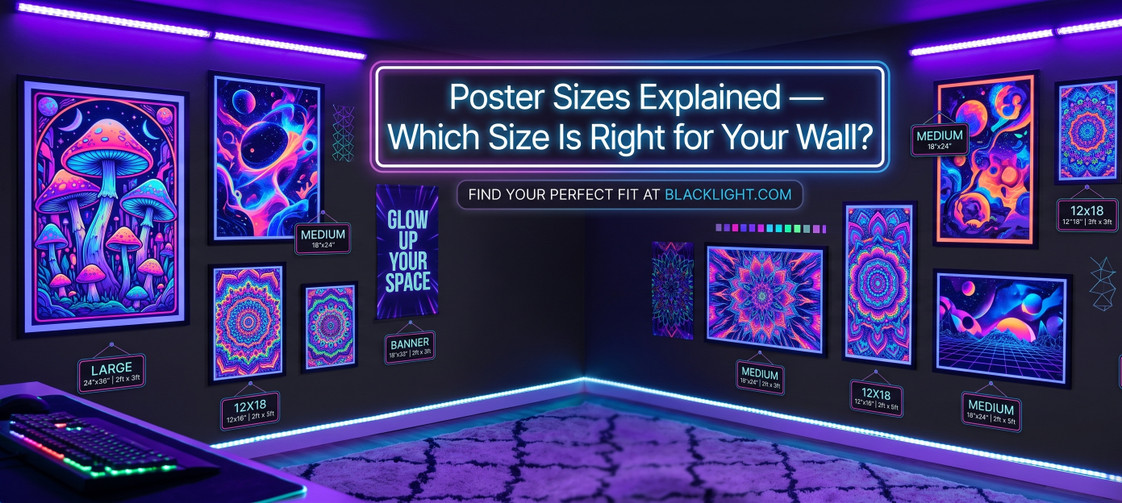
Poster Sizes Explained — Which Size Is Right for Your Wall?
5th Aug 2026
Buying a poster online is straightforward until you get to the size. Numbers like 24x36, 22x34, 23x35, 11x17 — listed in inches, sometimes without any visual reference — are easy to get wrong. Order too small and the poster looks lost on the wall. Order too large and it overwhelms the space or doesn't fit the spot you had in mind.
This guide covers every poster format available at Blacklight.com — what the actual dimensions look like on a wall, which spaces they work best in, and how to choose the right size for your specific situation without guessing.
The Standard Poster Sizes — What You Will Actually See
24" x 36" — Large Format (Most Popular)
The 24x36 is the standard large poster format and the most commonly purchased size for bedrooms, dorm rooms, and music rooms. At two feet wide and three feet tall, it is substantial enough to serve as a genuine anchor piece on most walls without overwhelming a standard-sized room.
How it looks on a wall: 24x36 is roughly the size of a movie one-sheet — the tall vertical posters you see in cinema lobbies. It commands attention from across the room and fills a significant portion of wall space above a desk or beside a bed.
Best for: Anchor pieces, feature walls, above the headboard, beside a desk or monitor, above a sofa. Any wall section where you want one statement piece rather than a gallery.
Not ideal for: Small walls under 4 feet wide, spaces that already have furniture competing for attention, or anywhere you want a more subtle decorative touch.
36" x 24" — Large Format Horizontal
The same area as 24x36 but in landscape orientation — three feet wide, two feet tall. Less common than the vertical format but highly effective for specific applications.
How it looks on a wall: Wide and cinematic. At 36 inches wide it spans most of the space behind a standard desk setup. The horizontal format feels more like a panoramic scene than a portrait — which suits certain subjects dramatically better.
Best for: Behind a dual-monitor setup (the 36-inch width matches the span of two monitors), above a wide headboard, in rooms where ceiling height is lower than average, or for poster art with naturally horizontal compositions like band group shots and landscape scenes.
23" x 35" — Blacklight Flocked Standard
The 23x35 is the standard size for blacklight flocked posters — the velvet UV-reactive format that Blacklight.com is known for. Fractionally smaller than 24x36 but functionally equivalent in how it looks on a wall.
How it looks on a wall: Essentially the same visual impact as 24x36. The one-inch difference in width and height is imperceptible in a room setting — these two sizes can be mixed in a gallery wall without the size difference being noticed.
Best for: Everything 24x36 is best for. The 23x35 format is specific to the flocked blacklight poster product — if you are building a blacklight room, this is the size you will work with most.
Browse Flocked Blacklight Posters 23x35 →
22.375" x 34" — Standard Anime and Pop Culture Format
The 22x34 (or 22.375x34 as it appears in the catalog) is a slightly smaller vertical format common in anime, K-Pop, and pop culture posters. Narrower than 24x36 by about 1.5 inches and shorter by about 2 inches.
How it looks on a wall: Slightly more compact than a 24x36 — still a strong statement piece but with a slightly slimmer, more elongated proportion. Works well in spaces where 24x36 would feel just slightly too large.
Best for: Anime poster walls, K-Pop fan rooms, gallery walls where you want slightly more breathing room between pieces, or walls with narrower sections.
11" x 17" — Mini Poster (Most Versatile)
The 11x17 is the workhorse of the mini poster format — large enough to be genuinely visible from across the room, small enough to mix with multiple other pieces without any one of them dominating. At just under A3 size, 11x17 is roughly the size of a standard school project poster.
How it looks on a wall: A single 11x17 on a large wall looks small. But three to five 11x17 pieces arranged as a cluster or grid create a cohesive gallery wall section that punches significantly above its individual weight. This is the format that gallery walls are built around.
Best for: Gallery walls with multiple pieces, filling smaller wall sections (beside a window, above a nightstand), dorm rooms where wall space is limited, and as supporting pieces around a large anchor poster. Also the most practical format for rotating collections — easy to swap in and out seasonally.
11" x 14" — Small Mini Poster
Smaller than the 11x17, the 11x14 is closer to a standard letter-size page with a small border. At this size it is best understood as a print rather than a poster — it works as part of a tightly arranged gallery wall or displayed in a frame on a desk rather than hung as a standalone wall piece.
Best for: Tight gallery wall arrangements, framed desk displays, supporting pieces in a large gallery wall where you want very small accent pieces between larger prints.
12" x 18" — Compact Poster
Slightly larger than 11x17, the 12x18 sits between the mini format and the standard large format. A useful size for spaces that are too small for 24x36 but need something more impactful than 11x17.
Best for: Bathroom walls (a great and underused space for poster art), narrow wall sections, bedroom accent walls where a large poster would overwhelm, and compact dorm rooms.
16" x 20" — Mid-Size Format
The 16x20 is the photography standard — the most common size for printed photographs and a natural upgrade from mini posters when you want more impact without committing to a full large-format piece.
Best for: Gallery walls where you want one or two slightly larger accent pieces without a full 24x36 anchor, photography and fine art prints, and rooms with medium-sized wall sections.
30" x 43" — Large Format Fabric Poster
Fabric posters come in their own format — 30x43 is significantly larger than the standard paper poster formats. At 2.5 feet wide and nearly 3.5 feet tall, a 30x43 fabric poster covers a wall section roughly equivalent to three standard 24x36 posters.
How it looks on a wall: Dramatic. A fabric poster at 30x43 is a statement in itself — it does not need supporting pieces to fill a wall, it is the wall. The fabric texture adds a dimension that paper cannot replicate.
Best for: Feature walls where you want maximum coverage, above a bed as a statement headboard piece, or in any space where you want the poster to function more like a tapestry than a print.
How to Choose the Right Size — Quick Decision Guide
Single statement piece for a bedroom or dorm wall: 24x36 or 23x35.
Behind a dual-monitor gaming or work setup: 36x24 horizontal.
Gallery wall with multiple pieces: Mix one 24x36 anchor with three to five 11x17 mini posters.
Small wall section or compact space: 12x18 or 16x20.
Blacklight poster room setup: 23x35 flocked format as the primary piece.
Maximum wall coverage, fabric aesthetic: 30x43 fabric poster.
Rotating collection or seasonal display: 11x17 — easy to swap, easy to store.
How to Measure Your Wall Before You Order
Step 1 — Measure the wall section where the poster will hang. Note the width and height in inches.
Step 2 — Subtract 6 inches from each dimension for breathing room on all sides. A poster should not touch the ceiling, the floor, or adjacent furniture or walls.
Step 3 — The remaining space is your usable area. Choose the largest poster size that fits within it.
Example: A wall section 36 inches wide and 48 inches tall gives you 30 inches of usable width and 42 inches of usable height. A 24x36 fits comfortably with room to spare. A 36x24 in horizontal orientation also works for the width but leaves significant space above and below.
Shop by Poster Size at Blacklight.com
Browse Mini Posters — All Sizes →
Browse Regular Posters — Large Format →
Browse Blacklight Flocked Posters 23x35 →
Buy 3 or more posters and save 10% automatically — great for building a gallery wall across multiple sizes.